Inference Operating System
for Token Factories
Turn heterogeneous infrastructure into production-ready throughput. Deploy models, engines, and accelerators faster, with higher utilization, lower latency, and better cost per token.





Why NR-NEXUS™
Take control of cost, performance, governance
Govern economics, performance, and execution through one operating system.
Cut your cost per token
Token-level cost, utilization, and SLO compliance by model, team, and tenant — consolidate workloads onto less hardware and show finance the difference.
SLOs you can commit to
Latency and throughput targets are checked before you deploy and enforced once you are live, so the service level you promise is the one you run.
Governance and security
Tenant isolation, quotas, RBAC, mTLS, and audit logs — governed inference for regulated workloads from day one.
Operational simplicity
One control plane instead of a stack of serving tools and custom operators. Move workloads across supported GPUs, XPUs, clouds and on-prem without a rebuild.
See what one operating system does to your cost per token.
 GPT-OSS
 Qwen
Qwen deepseek
 LLaMA
LLaMA Kimi
Kimi





Pre-deployment estimation
Know before you deploy
Set your model, workload, and SLO targets. NR-NEXUS™ projects whether you'll clear every target — throughput, latency, TTFT, GPU allocation — before a single token goes live.
Run a benchmark analysisArchitecture
Build a Better Token Factory
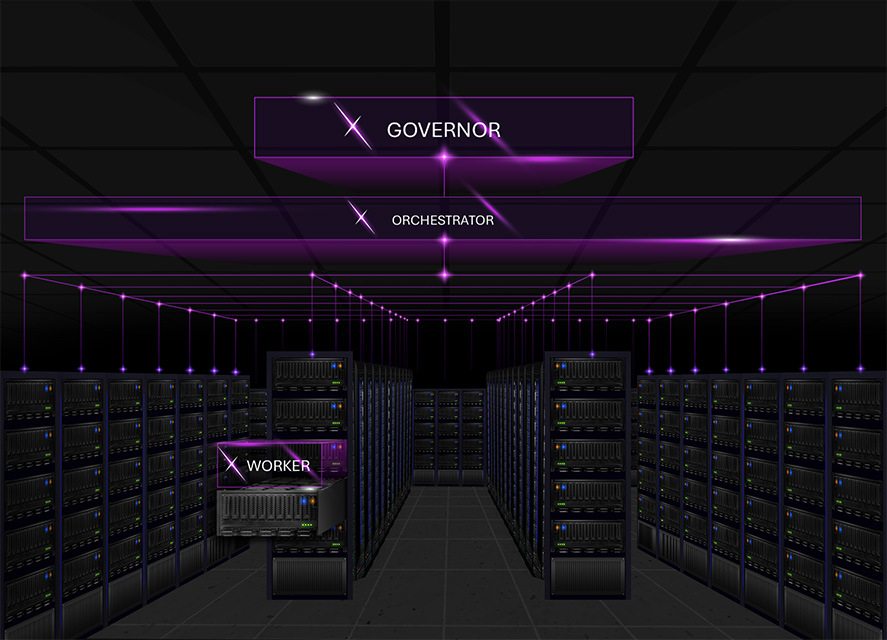
NR-NEXUS™ sits between your models and your hardware — governing, orchestrating, and executing every token.
Put this architecture on the hardware you already run.
Under the hood
Intelligent KV-cache management throughout
Most of the cost of serving a long conversation is re-reading what was already computed. NR-NEXUS™ routes around that instead of paying for it twice.
KV-aware routing
Routes requests on session affinity, prefix-cache locality, queue depth and transfer cost — avoiding repeated prefill and unnecessary KV movement.
Optimized KV-cache transfer
Streams KV-cache tiles from prefill to decode over optimized RDMA paths, letting decode begin before the full cache arrives.
Tiered KV-cache management
Keeps active context in accelerator memory and moves colder entries across host, local and remote storage tiers.
IN PRODUCTION
From 64 GPUs to 17
A production GenAI team ran one workload across 64 GPUs on a hand-built stack. The same workload now runs on 17, with better throughput and lower latency.
We stopped managing inference and started shipping product. The cost reporting alone paid for itself.
The shift
From DIY AI stacks to governed token output
NR-NEXUS™ replaces disconnected serving tools with one operating model for production inference: shared governance, coordinated orchestration, and optimized execution.
Custom scripts Manual tuning Idle infrastructure Brittle scaling Limited cost visibility
SLO classes Endpoint controls Telemetry Cost-per-token reporting Governed token delivery
Models
Choose the best model for your workload
Deploy the models your teams need — and mix or swap them without re-architecting.
LlamaDeepSeekQwenKimi MistralGPT-OSS
 Gemma
Gemma Phi
Phi GLM
GLM Nemotron
 MiniMax
See these numbers on your own workload.
Deployment
Three ways to run production inference
Evaluate on a serverless API, run production on reserved throughput, or license the full layer for your own infrastructure. Move between them without re-architecting.
Reserved Throughput
Dedicated endpoint
Run a production workload on reserved throughput with SLO visibility, autoscaling, tenant controls, observability, usage reporting and cost tracking. Best for workloads that require predictable service behaviour.
Annual NR-NEXUS™ License
Self-operated
Deploy NR-NEXUS™ on managed IaaS, customer-owned IaaS, or private infrastructure. Best for teams that want to operate their own token factory.
Serverless API
API-style access
API-style access for selected workloads with keys, metering, rate limits, streaming and dashboards. Best for evaluation and workload discovery.
New way to run
Deployment mode
Describe the way to run production inference in a sentence or two.
Ready to take control of your token factory?
See the results on your own infrastructure